


Healthcare organizations process enormous volumes of sensitive patient information every day. Protecting that information requires more than installing security tools or completing an annual compliance checklist. Yet many organizations still approach HIPAA assessments as a documentation exercise, expecting a quick questionnaire to provide a complete picture of their security posture.
A meaningful HIPAA assessment goes much deeper. It examines how electronic protected health information (ePHI) moves throughout the organization, how security controls operate in practice, and where weaknesses could expose patient data or disrupt clinical operations.
Understanding what a comprehensive assessment should include helps organizations make better decisions about security investments, regulatory readiness, and long-term governance. In this article, we’ll explore what distinguishes a thorough HIPAA assessment from a superficial review, the core areas every assessment should evaluate, and how those findings can support broader cybersecurity and compliance initiatives.
Why a Checklist Alone Isn’t Enough
Many HIPAA assessments begin and end with a questionnaire. Policies are reviewed, technical safeguards are acknowledged, and organizations receive a report stating whether required controls appear to be in place.
While documentation is important, quality healthcare focused MSPs like IT Total Care have seen that it only tells part of the story.
The HIPAA Security Rule requires covered entities and business associates to perform an accurate and thorough assessment of the potential risks and vulnerabilities affecting the confidentiality, integrity, and availability of electronic protected health information. That means evaluating not only whether controls exist, but whether they are implemented consistently and reduce real operational risk.
For example, an organization may have a documented access control policy requiring employees to use unique user accounts and multi-factor authentication. On paper, the requirement has been addressed. During an assessment, however, reviewers may discover former employees still have active accounts, privileged access is granted without approval, or shared administrator credentials are still being used. The policy exists, but the control is not operating as intended.
The same issue applies across many areas of security. Encryption may be enabled on servers but not on portable devices. Audit logs may be collected but never reviewed. Incident response procedures may exist, yet no one has tested them through tabletop exercises or simulations.
A comprehensive HIPAA assessment looks beyond documentation to determine whether security practices are functioning in day-to-day operations. It identifies gaps that create measurable business risk rather than simply confirming that required documents have been written.
Organizations that rely solely on checklist assessments often gain a false sense of confidence. The report may satisfy an internal requirement, but it provides little insight into the vulnerabilities that could contribute to a data breach, regulatory investigation, or disruption to patient care.
A thorough assessment provides something much more valuable: a clear understanding of where risks exist, why they matter, and which improvements should be prioritized first.
The Four Pillars of a Comprehensive HIPAA Assessment
A meaningful HIPAA assessment evaluates far more than technical controls. It examines the people, processes, technologies, and third-party relationships that influence how electronic protected health information is protected across the organization.
While every environment is different, most comprehensive assessments focus on four core areas.
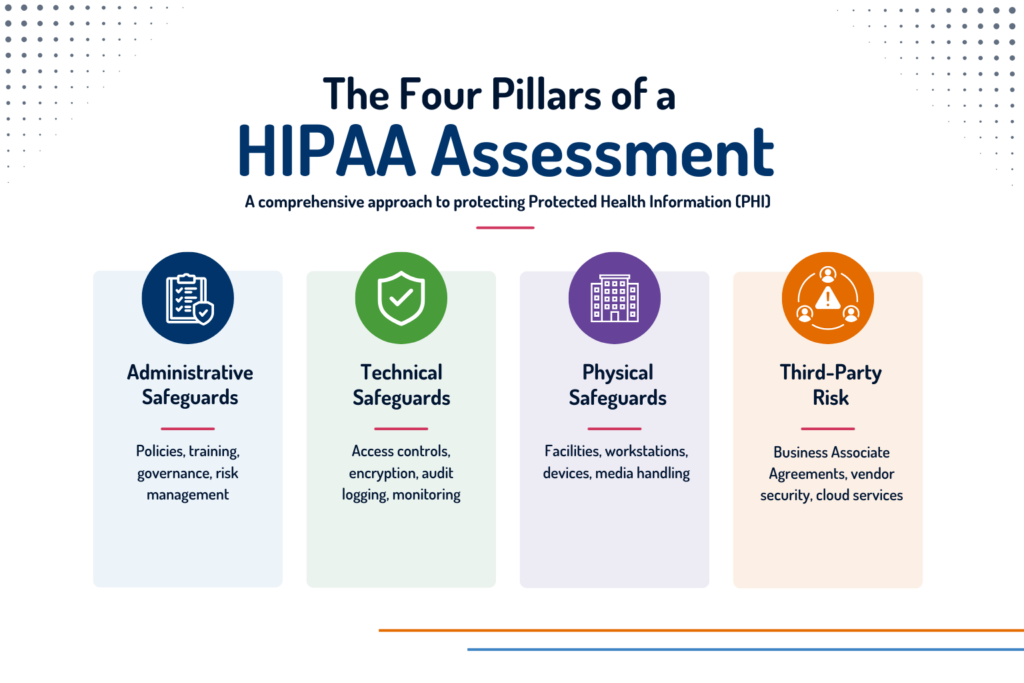
Administrative Safeguards → Policies, training, governance, risk management
Technical Safeguards → Access controls, encryption, audit logging, monitoring
Physical Safeguards → Facilities, workstations, devices, media handling
Third-Party Risk → Business Associate Agreements, vendor security, cloud services
1. Administrative Safeguards
Administrative safeguards establish the governance framework behind an organization’s security program. Rather than simply verifying that policies exist, a thorough assessment evaluates whether those policies are supported by everyday operational practices.
This includes reviewing how risks are identified and documented, how employees receive security awareness training, how access requests are approved, and how security responsibilities are assigned across the organization.
For example, a healthcare provider may have a documented incident response plan, but if employees have never participated in an exercise or management has never reviewed the process, the organization may struggle to respond effectively during an actual security incident.
The assessment also evaluates whether periodic risk analyses are performed and whether identified risks are tracked through remediation rather than remaining unresolved from year to year.
2. Technical Safeguards
Technical safeguards focus on the systems that protect electronic protected health information throughout its lifecycle.
This portion of the assessment typically reviews identity and access management, authentication mechanisms, encryption, system logging, endpoint protection, vulnerability management, and monitoring capabilities.
Rather than asking whether multi-factor authentication has been deployed, reviewers examine where it has been implemented, whether privileged accounts are adequately protected, and whether administrative access follows the principle of least privilege.
Similarly, collecting audit logs is only one part of the equation. Organizations should also demonstrate that logs are reviewed, unusual activity is investigated, and security events are escalated appropriately.
The objective is to determine whether technical controls are functioning together to reduce the likelihood and impact of unauthorized access.
3. Physical Safeguards
Healthcare organizations often focus heavily on digital security while overlooking physical risks that can expose patient information.
A comprehensive assessment evaluates how facilities, workstations, portable devices, and storage media are protected against unauthorized access.
This may include reviewing visitor access procedures, workstation placement, badge controls, device inventory processes, and secure disposal practices for equipment containing electronic protected health information.
For organizations with remote or hybrid employees, the assessment should also consider how laptops, mobile devices, and home work environments are managed to reduce the risk of data exposure outside traditional office locations.
Physical security remains an important component of protecting patient information because compromised devices can expose the same sensitive data as compromised systems.
4. Third-Party Risk
Very few healthcare organizations operate independently. Cloud providers, billing companies, software vendors, managed service providers, and other business associates frequently process or access electronic protected health information.
As a result, a HIPAA assessment should evaluate whether third-party relationships are governed appropriately.
This includes reviewing Business Associate Agreements, understanding which vendors access protected data, evaluating vendor security practices, and determining whether ongoing oversight exists throughout the relationship.
Many organizations discover that sensitive information flows through systems they had not previously considered during formal risk assessments. Mapping these data flows provides a more complete understanding of organizational risk and helps ensure security responsibilities are clearly defined across the entire ecosystem.
A comprehensive assessment recognizes that protecting patient information extends beyond internal systems. It also requires visibility into the partners and service providers that support day-to-day healthcare operations.
How GRSee Conducts a HIPAA Assessment
A HIPAA assessment should do more than identify compliance gaps. It should provide organizations with a practical understanding of where risk exists, why it matters, and how to reduce it. That requires a structured approach that combines governance, technical validation, and business context.
With high-quality consultants like GRSee Consulting, every engagement begins by defining the assessment scope. This includes identifying where electronic protected health information is stored, processed, or transmitted, understanding which systems support those activities, and mapping the internal and external parties involved. Establishing scope early helps ensure the assessment reflects the organization’s actual operating environment rather than relying on assumptions.
The next phase evaluates existing administrative, technical, and physical safeguards. Policies and procedures are reviewed alongside operational evidence to determine whether controls are functioning as intended. Rather than simply confirming that documentation exists, the assessment examines how security practices are implemented across day-to-day operations.
Technical reviews evaluate areas such as identity and access management, encryption, logging, endpoint protection, vulnerability management, and system monitoring. Administrative reviews focus on governance, workforce security, risk management, and incident response. Physical safeguards are assessed through controls surrounding facilities, devices, and media handling.
Vendor relationships also receive close attention. Many healthcare organizations rely on cloud providers, software vendors, managed service providers, and other business associates to support clinical and business operations. Understanding how those third parties access or process electronic protected health information helps organizations identify risks that may otherwise remain hidden.
Once the assessment is complete, findings are prioritized based on business impact and likelihood of exploitation. Not every issue requires immediate remediation, and treating every finding as equally critical often leads to inefficient use of time and resources. By evaluating technical risk alongside operational context, organizations can focus first on the controls that provide the greatest reduction in overall risk.
Rather than delivering a report that sits on a shelf, the assessment provides a roadmap for improving security over time. Leadership gains clear visibility into current risks, recommended remediation activities, and practical next steps for strengthening the organization’s security posture.
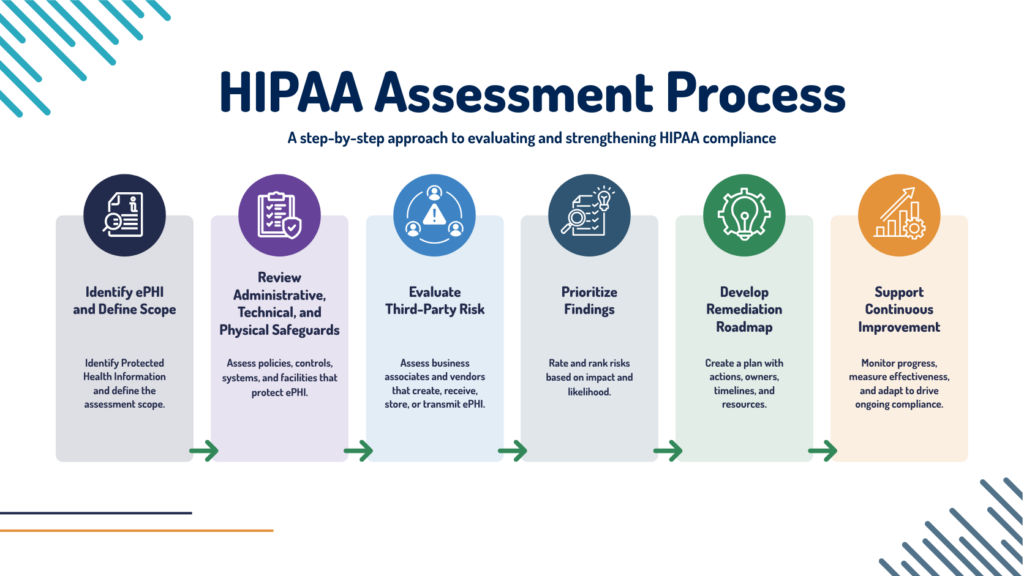
Identify ePHI and Define Scope → Review Administrative, Technical, and Physical Safeguards → Evaluate Third-Party Risk → Prioritize Findings → Develop Remediation Roadmap → Support Continuous Improvement
Looking Beyond HIPAA
A mature HIPAA program supports much more than regulatory compliance. Many of the controls evaluated during a HIPAA assessment overlap with broader governance and security frameworks, allowing organizations to strengthen multiple initiatives through a single improvement effort.
For example, identity and access management, risk assessments, incident response planning, security awareness training, vendor management, and continuous monitoring are also central components of SOC 2 engagements and the Privacy Trust Services Criteria. Organizations pursuing HITRUST certification likewise benefit from many of the same governance practices established during a thorough HIPAA assessment.
Technical validation also plays an important role. While a HIPAA assessment evaluates whether appropriate safeguards exist, activities such as vulnerability assessments and penetration testing help determine whether those safeguards can withstand real-world attacks. Together, governance reviews and technical testing provide a more complete understanding of organizational risk.
The result is a security program that extends beyond regulatory obligations. Instead of treating HIPAA as a standalone project, organizations can use it as the foundation for a broader governance strategy that improves operational resilience, strengthens customer and partner confidence, and supports future compliance initiatives as the business grows.
Why a Comprehensive HIPAA Assessment Matters
A HIPAA assessment should not be viewed as the end of a compliance project. It should serve as the starting point for continuous improvement.
Healthcare organizations operate in an environment where new technologies, evolving cyber threats, and changing business relationships continually introduce new risks. Cloud applications are adopted, vendors are added, employees change roles, and clinical workflows evolve. Each of these changes can affect how electronic protected health information is stored, accessed, or shared.
A comprehensive assessment provides the visibility needed to manage those changes with confidence. It helps organizations understand where their greatest risks lie, prioritize remediation efforts, and make informed decisions about future security investments.
More importantly, it demonstrates that security is being managed proactively rather than reactively. Whether responding to an audit, completing a customer security review, or preparing for future compliance initiatives, organizations with a mature risk assessment process are typically better positioned to demonstrate accountability and resilience.
Security is no longer measured by the number of policies an organization has documented. It is measured by how effectively those controls protect sensitive information in daily operations.
Building a Stronger Foundation for Healthcare Security
Protecting patient information requires more than meeting minimum regulatory expectations. It requires understanding how security controls operate across people, processes, technology, and third-party relationships, then continuously improving those controls as the organization evolves.
A thorough HIPAA assessment provides that foundation. Rather than producing a simple pass-or-fail outcome, it helps organizations identify meaningful risks, prioritize remediation, and strengthen their overall security program. The same governance practices established through a comprehensive assessment can also support broader initiatives such as SOC 2, the Privacy Trust Services Criteria, HITRUST, vendor risk management, and penetration testing, creating a more consistent and sustainable approach to cybersecurity.
At GRSee Consulting, we help organizations move beyond checklist compliance by delivering assessments that provide practical insight and actionable recommendations. Our goal is not simply to evaluate existing controls, but to help organizations build governance programs that protect patient data, support regulatory obligations, and strengthen long-term operational resilience.
If you’re planning a HIPAA assessment or want to understand how your current controls align with broader security and compliance objectives, schedule a conversation with the GRSee Consulting team. We’ll help you identify where you stand today and build a practical roadmap for strengthening your security program.
Ben Ben Aderet is the CEO and Co-Founder of GRSee Consulting, an international cybersecurity and compliance firm helping organizations strengthen their security posture through services including PCI DSS, SOC 2, ISO 27001, penetration testing, risk management, and vCISO. With more than 20 years of experience in information security, he has worked with financial, government, defense, and telecommunications organizations worldwide, helping them navigate complex security and compliance challenges.
GRSee is a cybersecurity and compliance firm providing SOC 2, ISO27001, HIPAA, penetration testing, and vCISO services to organizations with growing security requirements. Learn more here.